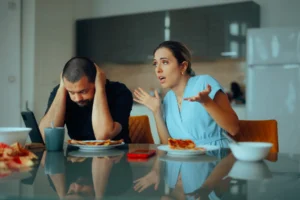


Husband Takes Me for Granted: Why It Happens and What to Do
If you find yourself thinking, “my husband takes me for granted,” you are not being dramatic or ungrateful. You are naming something real. The noticing itself matters, and it is usually the first honest signal that something in the relationship needs attention.
When a wife feels taken for granted, she is usually describing a slow accumulation: the effort she puts in has stopped being seen, the care she offers has become background noise, and the thank-yous have quietly disappeared. It is rarely one cruel moment. It is the drip of invisibility over months or years.
Here is the short answer we give to women who ask us about this in our counseling office. Feeling taken for granted in marriage is almost always about relational patterns, not about who your husband is as a person. It usually shows up when two things overlap: a slow drift in the marriage where attention and appreciation have faded, and a set of patterns in how you relate (often people-pleasing or codependency) that make it easier for that drift to go unchecked. Both pieces need care, and both can change.
This article is our attempt to help you make sense of what is happening and to point toward a way forward that respects both your experience and the work a real marriage actually takes.
The Slow Drift Toward Being Taken for Granted
Most marriages do not start out in this place. In the early years, appreciation is easy. You notice each other. You say thank you for small things. Affection is offered without being prompted.
Then life gets busier. Kids arrive. Jobs intensify. Parents age. Bills compete for attention. And somewhere in there, the appreciation habit quietly dies. Psychologists call this habituation: the brain stops registering what is familiar and predictable. Your husband is not choosing to stop noticing you. His nervous system has simply filed your presence under “constant,” and constants are what the brain tunes out.
This is not an excuse. It is a diagnosis of drift. Drift is the default in any long relationship that is not being actively tended. The good news is that what drifted can be reoriented, and the first step is naming it honestly instead of waiting for your husband to wake up on his own.
Marriage Roles and Expectations
Part of what makes being taken for granted so painful is that most of us carried a set of expectations into marriage that we never fully examined. We absorbed them from our families of origin, from the culture, from what our friends’ marriages looked like, from the stories we watched growing up.
Those expectations tell us what a good wife does, what a good husband does, and what love should look like on an ordinary Tuesday. When the real marriage stops matching the expected marriage, the gap shows up as a feeling. Sometimes the feeling is anger. Sometimes it is sadness. Often, for the wives we sit with, it is the quiet ache of being invisible to the person who was supposed to see her most clearly.
Before you can do much about the pattern, it helps to get curious about the expectations. What did you think marriage would feel like? Where did that picture come from? Is there space in it for both of you to be tired, imperfect, and still committed? Naming the expectation does not mean lowering the bar. It means giving yourself a chance to see the actual relationship, not the imagined one.
The People-Pleasing Pattern
Here is where things get more personal. For many of the women we work with, feeling taken for granted is tangled up with a lifelong habit of people-pleasing.
People-pleasing usually has roots. It often starts in childhood, in a family where love felt conditional on being helpful, quiet, agreeable, or low-maintenance. A child in that environment learns early that the safest way to stay connected is to anticipate what other people need and provide it before being asked. That child grows up, gets married, and brings the same operating system into her marriage.
On the outside, it looks like generosity. On the inside, it feels like a quiet contract: “If I keep giving, I will be loved and valued.” The problem is that your husband never signed that contract. He may not even know it exists. So he receives the giving as normal, not as a love deposit he owes interest on. Over time, the giving accumulates, the thank-yous do not, and resentment quietly builds.
People-pleasing is not a character flaw. It is an adaptation that worked for a long time and eventually stopped working. Recognizing it is the beginning of being able to choose something different.
The Codependency Pattern
Some women find that what started as people-pleasing has slid into something heavier: codependency. Codependency is what happens when your sense of worth becomes dependent on managing, caretaking, or rescuing the people around you. The marriage stops being a partnership between two whole people and starts being a system in which your wellbeing rides on how your husband is doing, how he is treating you, and whether he is meeting your unspoken needs.
Author Darlene Lancer offers a four-step path out of codependency that we often reference with clients. We find it clear, practical, and kind.
Abstinence. This is the deliberate choice to step back from the caretaking, rescuing, and controlling behaviors that have become automatic. Abstinence is not coldness. It is making room for yourself by stopping the behaviors that have been crowding you out of your own life.
Awareness. Once you stop moving at the old pace, feelings surface. Awareness is letting yourself notice what is actually there: grief, anger, exhaustion, longing. This is the part most of us would rather skip. It is also the part that opens the door.
Acceptance. Acceptance is not approval and it is not resignation. It is the honest acknowledgment that this is what is, that you did not cause all of it, and that you cannot control your husband into becoming someone who naturally notices you. Acceptance is where you finally get to put down what was never yours to carry.
Action. Action is what becomes possible once the first three are in place. It is asking for what you need clearly. It is setting boundaries you are willing to follow through on. It is reconnecting with the parts of yourself that got shelved somewhere along the way. Action without the first three steps usually collapses. Action grounded in the first three has a chance to stick.
A Note on Your Spouse’s Role
We want to be honest about something. Nothing in this article takes your husband off the hook. If he has slipped into treating you like the furniture, that is real and it matters. Part of a healthy marriage is both spouses taking responsibility for noticing each other, speaking appreciation out loud, and doing the small acts that keep the relationship alive.
At the same time, you cannot change him by waiting. You can only change your own patterns and then invite him into a different kind of conversation from that new place. For many couples, that invitation is the thing that finally moves the marriage. For some, it reveals that deeper work is needed, and that is information worth having.
If you are not sure where your marriage sits on that spectrum, our complete guide to counseling for husband and wife walks through what healthy repair can look like when both partners are willing to engage.
Frequently Asked Questions
Why does my husband take me for granted?
In most marriages, being taken for granted is the product of relational drift rather than a decision your husband made. The brain tunes out what is familiar and predictable, so the care you offer stops registering as remarkable. Layered on top of that, patterns like people-pleasing or codependency can make it harder for either of you to notice and correct the drift. The combination is what produces the feeling of being invisible in your own marriage.
What should I do when my spouse takes me for granted?
Start with yourself before you start with him. Notice the pattern honestly, name it out loud to yourself, and get curious about the expectations and habits that have been keeping it in place. From there, you can begin to speak clearly about what you need instead of hoping he will guess. Many women find that working with a counselor helps them untangle their own patterns before having the hard conversation with their husband, and that usually makes the conversation more productive when it happens.
Is feeling taken for granted a sign of codependency?
Not always. Sometimes it is a signal that the marriage has drifted and needs intentional repair on both sides. But if you notice that your sense of worth rides almost entirely on how your husband is treating you, that you feel responsible for managing his moods, or that you have a long history of giving more than you receive in most of your relationships, codependency may be part of the picture. A trained counselor can help you sort out which parts are drift, which parts are pattern, and what to do with each.
Can couples counseling help when one partner feels taken for granted?
Yes, and in our experience it often does. Couples counseling gives both partners a structured space to say things that have been hard to say at home, to be heard without the conversation spiraling, and to practice new ways of noticing each other. It works best when both spouses are willing to show up and engage honestly. If your husband is not ready to come in yet, individual counseling is still a meaningful place to start.
Moving Forward
If you have read this far, you already know something important. The feeling of being taken for granted is information, not a life sentence. It is telling you that something in the marriage has drifted and that something in your own relational patterns may be due for attention. Both of those are workable.
We would be honored to walk with you on that work. Our couples counseling practice exists for moments exactly like this one, where a wife is ready to stop waiting to be noticed and start building a marriage where both partners are genuinely present to each other. When you are ready, we are here.
This article is for educational purposes and is not a substitute for counseling with a registered clinician. If you are in a situation involving abuse or immediate safety concerns, please reach out to a qualified professional or local support service in your area.
References
Lancer, D. (2015). Codependency for Dummies (2nd ed.). John Wiley & Sons.
Podcast: Play in new window | Download
 January 15, 2020
A stronger marriage is possible.
Our couples therapists help partners break unhealthy patterns, communicate more effectively, and rebuild the connection that brought them together.
See if couples counseling is right for you