


When Betrayal Interrupts Your Own Intimacy: Intrusive Images During Sex
It finally felt like a good moment. You reached for your partner, or they reached for you, and you said yes because you wanted the intimacy, wanted a few minutes where the betrayal was not in the room. Then it was in the room. An image arrived uninvited. Your chest tightened, your arousal drained away, and you no longer wanted to continue.
Intrusive images during intimacy after betrayal are common, deeply distressing, and often carried in silence by betrayed partners. They show up during sex because sex is one of the most undefended moments your relationship has, and your nervous system knows where you feel most exposed. The way back is not powering through. It is a slower, kinder set of skills called somatic pacing: staying present in your own body, at your own speed, with the full right to stop.
This article is for you, the partner who was betrayed. Near the end I will also speak directly to the partner who did the betraying, because how they respond in these exact moments matters enormously.
Why the Images Choose Your Most Undefended Moment
In Emotionally Focused Therapy, the model I practice from as a Marriage and Family Therapist, betrayal is understood as an attachment injury: a moment of great need when your partner was not there for you, and the bond itself took the wound. What makes betrayal different from other hurts is that the injury was not a single bad moment. Your partner chose to deceive you, repeated that choice, and concealed it. Your body kept the ledger even when your mind wanted to close the book.
Sue Johnson, the developer of Emotionally Focused Therapy, put the sexual piece simply: as we connect emotionally, so we connect sexually. Your sexual connection rests on your attachment connection, which means the state of the bond often shows up in bed before it shows up anywhere else.
Now think about what sex asks of you. It asks you to lower every defense you have: clothing, guardedness, vigilance, all of it. Your nervous system runs a quiet calculation in that moment, because the person you are being vulnerable with is the same person whose choices taught your body that danger can wear a familiar face. So the alarm fires precisely there. The image is your mind’s alarm system replaying the threat in the one moment you are most exposed.
If you have noticed that everyday moments can set you off too, a phone carried into the bathroom, a screen clicked dark, that same hypervigilance is at work, and we have written about betrayal trauma triggers in daily life separately. The bedroom version is the same mechanism at its highest intensity.
Because so many betrayed partners carry these moments in silence, the research matters: a study published in Stress and Health found that between 30 and 60 percent of betrayed partners experience symptoms of post-traumatic stress, depression, or anxiety at clinically meaningful levels. That does not mean betrayal automatically equals a PTSD diagnosis. It means your reactions follow a recognizable trauma pattern. Notably, the same research found that when betrayed partners were finally given a trauma framework for what they were experiencing, they described feeling clarity, validation, and relief.
Freeze, Lost Arousal, Leaving Your Body: What Each Response Is Doing for You
The three responses that tend to follow an intrusive image are freezing, losing arousal, and dissociating. Each one is your body working on your behalf, and I want to walk through them slowly, because what betrayed partners often tell me in session is some version of “my body keeps sabotaging us.” I would gently offer the opposite reading: your body noticed something real, and it is guarding you.
The freeze
When the image arrives, many partners describe going still. Muscles tense, breath goes shallow, and you cannot make yourself move or speak. Here is the mechanism: when a threat signal fires and the threat is also the person you love, your body’s usual options of fighting or leaving are in conflict with your attachment to them, so your system chooses stillness. Freeze is what protection looks like when your body refuses to pick between safety and love.
The arousal that disappears
Arousal is what your body produces when it believes it is safe enough to be swept up. The image announced danger, so your body did the sensible thing and shut the process down. This can feel humiliating in the moment, especially if your partner takes it personally. But desire that switches off under threat is a well-calibrated system doing its job.
Leaving your body
Sometimes your mind finds an exit door: you stay physically present while your awareness steps out of the room. Clinically, we call this dissociation. Partners describe watching themselves from a distance, going through the motions, or suddenly noticing the ceiling, the grocery list, anything but the bed. When leaving the room is not an option your heart is ready to choose, your mind leaves instead. That is not weakness. It is the oldest protective move trauma knows.
Maybe you have been carrying these moments as evidence against yourself: proof you are broken, frigid, or incapable of moving on. I want to hand that evidence back. Everything on that list is your system saying the injury has not been fully tended yet. That is information, and information this clear is actually something we can work with.

Why Can’t I Just Push Through It?
Many betrayed partners try to white-knuckle their way past the images: eyes shut, jaw set, waiting for it to be over. I understand the instinct. You want your marriage back, you may be afraid of what stopping will do to your partner, and you are tired of the betrayal taking one more thing from you.
Here is why powering through tends to backfire. Think of your responses as paths through the woods. Every time you have sex while frozen or checked out, you walk the same path again: the one where the bed is a place your feelings get overridden. The path gets more worn, easier for your body to take automatically, and the freeze arrives faster next time. Enduring sex teaches your body that sex is something to be endured.
There is also a quieter cost. Sex you push through out of fear, obligation, or the hope of keeping your partner from wandering is disconnected sex, and it usually leaves you lonelier than no sex at all. The goal was closeness, and the pushing through moves you further from it.
One caveat belongs here: the answer is not avoiding sexual intimacy indefinitely either, because avoidance carves its own path. The answer is pacing, which is a different thing entirely from either enduring or avoiding. And if you are in the opposite season right now, reaching for your partner with an intensity that confuses you, that surge has a name too. We cover it in our article on hysterical bonding after betrayal.
Somatic Pacing: How to Stay in Your Own Body
Somatic pacing means letting your body set the speed of sexual reconnection and giving it real tools for the moments it gets overwhelmed. The aim is modest on purpose: not fireworks, just presence. You, in your own body, in this moment, with this partner, for as long as that feels tolerable, and a graceful exit when it does not.
There is encouraging science underneath this approach. A study in the Journal of Traumatic Stress found that the link between betrayal trauma and symptoms like intrusion and avoidance runs largely through difficulties with emotion regulation. That is hopeful news, because regulation is a skill, and skills can be learned.
Name it out loud
Sue Johnson observed that naming an emotion begins regulating it. The same is true of the image. A short, agreed-on phrase like “an image just came, I need a minute” does two things at once: it interrupts the spiral in your own mind, and it turns a solitary flashback into a moment your partner can actually respond to. You do not have to describe the image. Naming that it arrived is enough.
Agree on a stop signal before you start
Decide together, ahead of time, that either of you can pause or stop at any point, for any reason, with no explanation owed and no repair required afterward. This changes the psychology of the whole encounter, because a body that knows the door is unlocked can relax inside the room. Without a real exit, your only options are pushing through or avoiding, and we have already seen where both of those lead.
Keep your senses in the present
Intrusive images pull you into the past, so recruit your senses to argue for the present. Keep your eyes open. Keep a light on. Look at your partner’s face, because their face now is not the image. Notice five things you can physically feel: the sheet, the temperature, your own breath. In trauma work we hold a principle that applies directly here: grounding is often more helpful than deepening. You are not trying to feel more in these moments. You are trying to stay.
Find your body’s calm anchor
In my brainspotting training, this is called a body resource: one place in your body that stays calm even when the rest of you is activated. For many people it is the soles of the feet, the breath moving at the chest, even the tips of the ears. Find yours during a calm moment, practice returning attention to it daily, and it becomes a home base you can reach for mid-encounter when the image hits. The goal is to stay inside your window of tolerance, the zone where sensations are uncomfortable but still tolerable, rather than getting swept past it.
Rebuild touch in stages
You do not have to choose between full sexual intimacy and no touch at all. A 2025 paper in the journal Sexual Health & Compulsivity describes a trauma-informed adaptation of sensate focus that fits betrayed partners well: map which kinds of touch feel safe and which feel loaded, build in scheduled pauses to check what your body is doing, and let touch progress in stages you control, starting with touch that has no sexual agenda at all. Holding hands, a long hug, sitting close. These are not consolation prizes. They are the actual retraining, one tolerable step at a time, and they build the new path your body will eventually trust.

If You Are the Partner Who Betrayed: What These Moments Ask of You
I want to speak to you directly, because you are in the room when the image arrives, and what you do next either tends the injury or deepens it.
First, the hard naming. Your partner’s body is responding to something you chose, repeated, and concealed. The freeze is not rejection of you. It is the echo of the deception, arriving on schedule. Before any of the pacing work above can help, your partner deserves to have that named clearly and without defensiveness: the lying and the hiding were choices, and their body is responding to real events, not inventing a problem out of nowhere.
Now the moment itself. When your partner freezes or asks to stop, the single most damaging thing you can do is make the moment about your own disappointment. The sigh, the hurt silence, the rolling away, the “I thought we were past this”: every one of those converts their flashback into your grievance, and it teaches their nervous system that honesty about their body costs them the relationship. That lesson can set your recovery as a couple back in painful and unnecessary ways.
What helps is almost embarrassingly simple. Stay. Stay warm. Ask “how are you?” and mean it. In Emotionally Focused Therapy we describe what a secure partner offers in three words: accessibility, responsiveness, and emotional engagement. In this moment that looks like turning toward your partner, letting their experience actually land in you, and staying anchored while the feeling is big instead of fixing, defending, or withdrawing into your own shame.
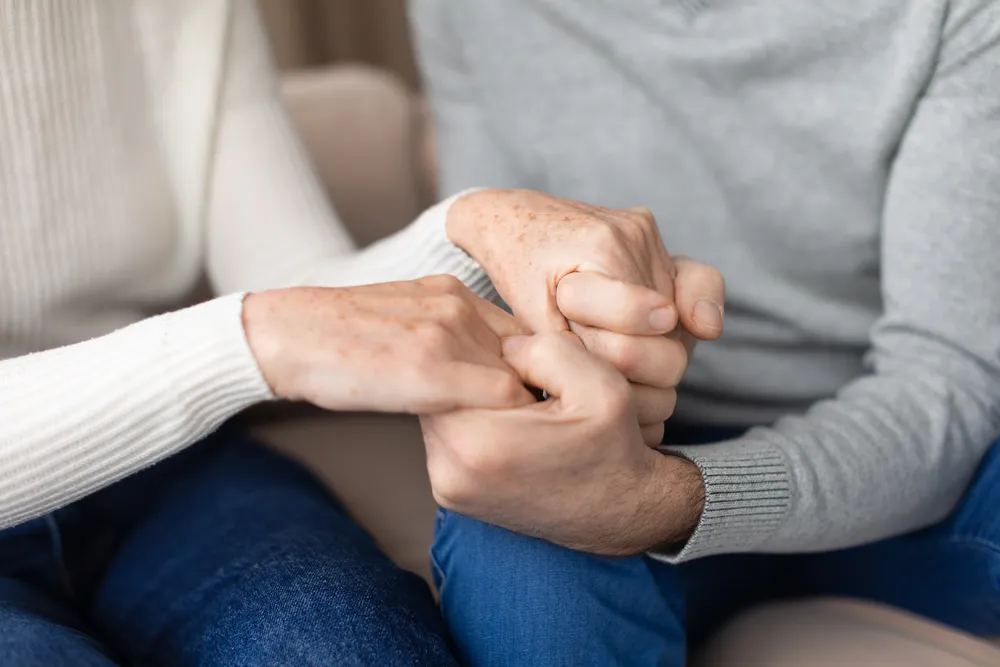
And do not underestimate what your calm, non-demanding presence does at the level of the body. In a well-known fMRI study by researcher James Coan, cited widely by Sue Johnson, people threatened with an electric shock showed dramatically lower threat activation in the brain while holding a trusted partner’s hand. Your steadiness in these moments is not a consolation prize while you wait for sex to come back. It is co-regulation, and it is the very material trust gets rebuilt from.
The Images Are Not the End of Your Story
The images intrude during sex because sex is where you are most undefended, and your body guards the place where the injury lives. Freeze, lost arousal, and dissociation are protection, not malfunction. Powering through wears the wrong path deeper. Somatic pacing walks a new one: naming, stop signals, grounding, a body anchor, and staged touch.
In attachment research there is a finding I return to with almost every couple I work with: security is not the absence of rifts. It is the confidence that rifts can be mended. The same is true here. A sexual relationship after betrayal is not resumed; it is rebuilt, and couples who do this work sometimes describe reaching something they did not have before: a sexuality where emotional intimacy and physical connection begin to belong together. The bond can be renewed. Your body, the one that has been interrupting sex to protect you, will be the first to tell you when it is becoming real.
If your nervous system’s reactions to the betrayal are still running your days as well as your nights, our guide to how betrayal trauma impacts the brain and body walks through the wider picture.
Frequently Asked Questions
Are intrusive images during sex normal after betrayal?
Yes, intrusive images are one of the most common trauma responses betrayed partners experience, and intimacy is their most frequent arrival point. Research in Stress and Health found 30 to 60 percent of betrayed partners experience clinically meaningful symptoms of post-traumatic stress, depression, or anxiety, and intrusion is a core part of that pattern. Their timing reflects the vulnerability of the moment, not the direction of your healing.
What do I say to my partner when an image hits in the middle of sex?
Name it briefly and ask for what you need: “An image just came. I need a minute.” Saying it out loud begins regulating the emotion and lets your partner respond with care instead of guessing. Some couples pause, ground, and continue; others stop and just hold each other. Both count as wins, because you stayed honest with your body instead of abandoning it.
Will the intrusive images ever go away?
For most betrayed partners, the images lose frequency and force as the trauma is processed, though timelines vary widely. Trauma-focused therapies such as EMDR and brainspotting are designed to work with exactly this kind of stuck sensory material. If the images stay vivid and frequent many months after disclosure, that is a signal to bring a trauma-trained therapist alongside you rather than a verdict on your progress.
Does freezing during sex mean our relationship can’t recover?
Freezing is a protective response to an attachment injury, and it says more about what happened to you than about what is possible for you. In Emotionally Focused Therapy terms, the bond can be rebuilt when the partner who caused the injury responds to these moments with accessibility, responsiveness, and emotional engagement. Couples who learn to pause and repair often build a more secure sexual connection than they had before.
You should not have to figure out these moments alone, and you were never meant to. Our team includes therapists trained specifically in betrayal trauma, and we walk with betrayed partners through exactly this territory: the images, the freeze, and the slow, real work of coming home to your own body. If that support would help, healing for the betrayed is where to start, and a free consultation is a low-pressure first step.
Podcast: Play in new window | Download
 August 6, 2026
What happened to you was not your fault.
Our therapists specialize in betrayal trauma. They understand the shock, the grief, and the questions that keep you up at night. You deserve support that actually gets it.
Find the support you deserve