
“I’m Just Not an Emotional Person”: Learning to Name What You Feel
There is a question therapists are famous for, and we ask it a lot: “What are you feeling right now?” Very often the answer is “I don’t know.” And all the time, especially from male clients, we hear some version of “I’m just not an emotional person.”
We believe that you believe it. We don’t think it’s true.
If you want to know how to identify your emotions, the short version goes like this: call up the exact moment that bothered you, notice where your body reacts when you do, stay with that spot, and then find the feeling word that fits what is happening there. That’s the whole skill. Most of the people we work with in porn and sex addiction recovery, and many who have betrayed a partner, were never shown how to do it. They have plenty of feelings. Nobody taught them to connect those feelings to words.
You Are Emotional. Nobody Gave You the Words
Picture a kid with a math test in the morning who says their stomach hurts. One parent says, “Of course your stomach hurts a little. You’ve got a big test tomorrow and you’re nervous.” Another parent says, “You’re fine, go to bed.” Or hands over an antacid. Or isn’t in the room.
The first kid just got a small lesson: that thing in my belly has a name, the name is nervous, and it makes sense that I have it. Repeat that a few thousand times across a childhood and you get an adult who can say “I’m anxious about tomorrow” without stopping to think. The second kid gets a stomachache and no word to go with it. Thirty years later that kid is sitting across from one of us with a knot in their gut, saying they feel nothing.
It’s those simple, ordinary moments, the ones that didn’t happen, that leave a person emotionally illiterate. We don’t use that word as an insult. Illiterate only means nobody taught you to read.
You know what it’s like to have a word on the tip of your tongue. It’s there. You can almost feel its shape. The harder you reach for it, the further it slides. For many of our clients that is exactly what “what are you feeling?” is like. Something is present, they can’t retrieve it on demand, and being watched by a therapist or a hurting partner while they try makes it worse.
The one feeling boys are handed
For a lot of boys there’s a second layer. Anger is often the only feeling that’s really acceptable. Sad gets you teased and scared gets you called soft, so everything ends up routed through the one channel that’s allowed.
The research on this is more specific than “boys don’t get talked to about feelings.” Aznar and Tenenbaum pooled 34 samples, more than 3,600 people, for a 2020 paper in Sex Roles and found no real difference in how much mothers talk about emotions with sons compared with daughters. Where the difference shows up is in which emotions get airtime. A Dutch team led by van der Pol watched 317 families read a picture book about feelings with their young children and wrote it up in the journal Emotion in 2015: parents tended to call the angry child in the pictures a boy, and the sad and happy children girls. Years earlier, in a 1991 study in the Journal of Narrative and Life History, Robyn Fivush had found mothers lingering over sadness with their daughters and accepting anger from their sons.
So you were probably talked to. You were taught one feeling, and told without anyone ever saying it out loud that the rest were not for you.
Men are as emotional as women. When Jara Mendia’s group combined 120 studies and nearly 89,000 people in Personality and Individual Differences in 2024, the gaps between men and women were small and they did not all run the same way. Men scored a little higher on trouble describing feelings to other people. Women scored a little higher on trouble identifying them in the first place. The one larger difference was that men were more in the habit of pointing attention outward, at tasks and events, and away from what’s going on inside. A habit of attention can be retrained.
We see the same blank in women. Less often, because girls are generally socialized to talk about a wider range of feelings. But a woman who grew up in a neglectful home lands in our practice in the same spot and needs the same basic teaching. There’s no shame in that, and she picks it up just as quickly.
What It Costs You in Recovery and at Home
A feeling you can’t name doesn’t go away. It still has to go somewhere. In the Certified Sex Addiction Therapist training behind our addiction work, clinicians are taught to look for the intolerable feelings a person is medicating with the behavior, and it is very hard to stop medicating something you can’t identify.
This link has been turning up in the research for a while. Rory Reid and his colleagues tested 120 people seeking help for hypersexual behavior for a 2008 paper in the Journal of Sex & Marital Therapy, and difficulty identifying feelings made a modest but real contribution to how severe the behavior was, even after depression and stress were accounted for. More recently, Magdalena Wizła and her colleague Lewczuk surveyed about a thousand adults for Archives of Sexual Behavior in 2024 and found that trouble regulating emotions accounted for part of the link between insecure attachment and both compulsive sexual behavior and problematic porn use.
The study that stays with us came out this fall in Acta Psychologica. Jannis Engel’s team in Hannover put 40 men with compulsive sexual behavior disorder and 33 men without it through an emotion task in a brain scanner. On questionnaires, the first group reported far more trouble identifying and managing their feelings. Then both groups looked at upsetting images, and they rated them the same. The scans showed no clear difference between the groups either. It’s one small study, all heterosexual men, and the authors don’t oversell it. It does match what we see, though: the feeling registers, and what’s missing is the route from the feeling to a word.
We went looking for a study that tests whether teaching someone to name their feelings reduces porn use or acting out, and we could not find one. The studies above are each a snapshot of one moment in time. What the evidence does support is that the naming skill itself can be learned.
At home, the cost has a sound, and it’s “I don’t know.” A lot of people who betrayed their partner answer the hardest questions that way, and it is infuriating for the betrayed partner. It reads as not caring. Not caring enough to figure out the answer, not caring enough to try to remember, not caring enough to even try. Sometimes shame is flooding the system, which we’ve written about in why the betrayer shuts down. Often it’s simpler than that. They really don’t know, because they never learned how to find out.
When “What Are You Feeling?” Gets a Thought for an Answer
When we ask a client what they were feeling, most of the time they tell us what they were thinking. “I felt like my boss threw me under the bus.” “I didn’t like how that went.” “I feel like it wasn’t fair.” All reasonable things to think, and not one of them is a feeling.
There’s an easy test. Swap “I feel” for “I think” and see if the sentence survives. “I feel like you never listen to me” becomes “I think you never listen to me,” which works fine, so it was a thought. “I feel sad when you don’t listen” becomes “I think sad when you don’t listen.” That one falls apart, which tells you it was a real feeling.
Feelings are usually one word: sad, scared, ashamed, lonely, hurt, relieved, proud. If it takes a whole sentence to say, and especially if “like” or “that” comes right after “feel,” you’ve wandered up into your head. Nothing wrong with being there. The feeling just lives somewhere else.
How to Identify Your Emotions: Start in Your Body
Take something ordinary. Say you were in a meeting today and your idea got waved off in front of the whole team. You’ve been off ever since. You get home, your partner asks what’s wrong, and you say, “Nothing. Long day.”
In session we’d slow you right down.
First we’d ask you to go back to the exact moment. Not the whole meeting. The second it went sideways: the comment, the look on someone’s face, the silence afterward. Hold it like a photograph.
Then, with that picture in mind, we’d ask what you notice in your body. It can seem like an odd question. Stay with it anyway. Scan from your face down through your jaw, throat, chest, stomach, arms and hands. Something is almost always happening somewhere. Tight, hot, heavy, hollow, buzzing.
We go to that spot and we stay there for a bit. Describe it before you try to name it.
We say this out loud to clients all the time: a feeling is called a feeling because you feel it. It is an emotion showing up in your body as a physical experience, in a particular place.
Where feelings tend to show up

People differ, but certain feelings land in the same places for a lot of us. This is the rough map we use with clients:
- Anger: tightness in the jaw, or in the forearms and hands
- Shame: heat in the neck or the face
- Sadness: the throat, or behind the eyes
- Grief: close to sadness, though it sometimes arrives as a piercing pain in the chest, right at the heart
- Anxiety: the gut, somewhere in the belly
There is real science behind the idea. We often pull up a set of colored body silhouettes for clients, and they come from a Finnish team led by Lauri Nummenmaa. They asked 701 people to color in where each emotion felt stronger or weaker in the body, then published the maps in the Proceedings of the National Academy of Sciences in 2014. The patterns held up from person to person, in Western European and East Asian samples alike. Anger showed up in the arms and hands. Sadness came with a draining of the limbs. Most of the basic emotions registered in the upper chest. Their maps and ours don’t agree on every detail, and yours won’t either, so treat the list as a first guess.
Chantelle Lloyd and her colleagues used the same coloring tool for a 2021 paper in Child Abuse & Neglect, with 98 adults who had been maltreated or neglected as children. The ones who struggled to name feelings drew maps that were muted and blurry. The others drew sharp, localized ones. Blurry is a normal place to start.
Finding the word
Back to the meeting. Say what you find is heat in your face and neck.
We’re watching for a particular moment here, the small “oh” when a word lands and fits both the spot in your body and what actually happened. Heat in the face, dismissed in front of colleagues. That’s shame, or its cousin embarrassment. You’ll usually know when you’ve got it, because something eases a little.
The word has to make sense for the situation too. If it fits the body and not the story, keep looking.
That easing is not your imagination. Matthew Lieberman’s lab at UCLA showed in a 2007 Psychological Science paper that putting a feeling into a word turned down the amygdala’s response to upsetting images. Naming it takes some of the charge out.
Build the Map So You Can Use It Next Time
Every time you do this, you are mapping where feelings show up in your own body. The next time your face goes hot while something embarrassing is happening, you don’t have to start from zero. It’s probably shame, and now you can put a label on it.
A few things we send clients home with.
Get a feelings wheel. Robert Plutchik’s wheel of emotions is the classic one, built around eight primary feelings (anger, fear, anticipation, surprise, sadness, joy, trust and disgust) that fan out into finer shades. Print one and keep it where you’ll see it. We sometimes encourage clients to buy a feelings wheel cushion on Etsy and leave it on the couch where the hard conversations tend to happen. It sounds a bit silly. It works, because the words are sitting right there when your mind goes blank.
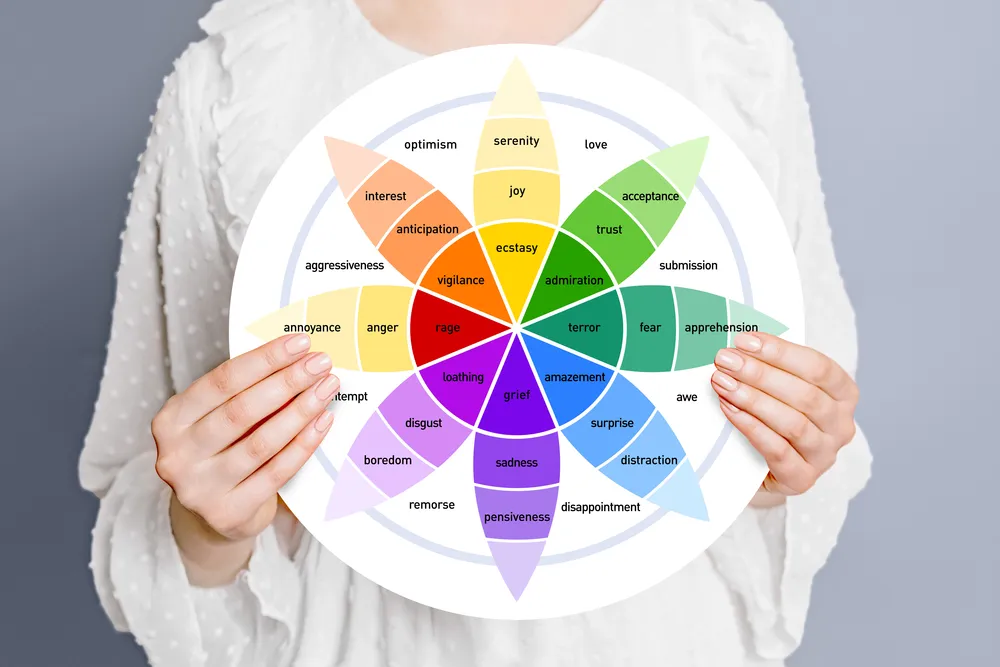
We also point people to an app called How We Feel, made by a nonprofit. It’s a simple way to practice checking in and picking a word.
Beyond the tools, it’s mostly small habits. Five minutes of stillness with no phone, so the quieter feelings have room to surface. Three sentences in a notebook. A quick look back before bed: what happened today, where did I feel it, what was the word? This skill grows by repetition far more than by breakthrough.
How Do You Tell Your Partner What You’re Feeling?

Once you can find the word, say it out loud to the person closest to you. “I’m feeling shame right now.” It’s more exposed than “I’m fine,” and it moves you toward them.
A boundary first. We’re talking about naming a feeling in an ordinary conversation. We are not suggesting you do your recovery work with your partner. That belongs with a therapist, a group or a sponsor, and your partner didn’t sign up to be your counselor. All of this also assumes a baseline of physical and emotional safety on both sides.
If you are the one who betrayed your partner, there is a specific place this matters. They ask you something like “What are you feeling right now?” or “Do you feel anything at all about what you did?” And you say, “I don’t know.”
You already know how that lands. So try something else, and expect it to come out clunky. Pause. Check your body. Then say what you find and the story that goes with it:
“Hang on. My face is hot. I think that’s shame. I think I’m feeling shame because you asked me that, and the story in my head is that I’m a terrible person and you’re finally seeing it.”
Nobody would call that polished. It is a feeling word plus the thing you are telling yourself, and for a partner who has been getting a blank wall, it is a huge gift. It won’t solve the whole problem. It will help more than you’d expect.
Two cautions. A feeling word doesn’t answer a factual question, so if your partner asked what happened, they are still owed the truth. And telling them what you feel doesn’t put them on the hook to comfort you. You are letting them see inside, which is different from asking them to fix it.
When All You Can Find Is Numb
Sometimes a person scans their body and comes back with “numb.” We hear it from people in addiction recovery and we hear it from betrayed partners. It usually means one of two things.
The first is what this whole article has been about. You haven’t learned to read your body yet, and “numb” is the word you reach for when you looked and couldn’t make anything out.
The second is that the numbness is doing a job. In Internal Family Systems language it’s a protector: a state your system learned to produce so that anger, sadness, grief and helplessness can’t get through. For a betrayed partner in the weeks after discovery, it can be a trauma shutdown, a kind of collapse, and we cover what that does physically in how betrayal trauma impacts the brain and body.
Either way, the way in is to get curious about the numbness itself. That’s tricky at first, because in your mind numb can pass for nothing. But having no feeling, feeling calm, and feeling numb are three different experiences. When you sit with numb for a while you can sense its texture, a kind of masking or whiting-out. Calm doesn’t have that. Learning to tell them apart is a real gain. For some people it takes a while, and we’ve never met anyone who couldn’t do it.
If You Are Autistic, or This Just Comes Harder
Some people are wired in a way that makes all of this harder, and struggling with it does not mean you are autistic. The two do overlap, though. Emma Kinnaird and her colleagues pulled together 15 studies for European Psychiatry in 2019 and found that about half of autistic participants had significant trouble identifying feelings, compared with about 5 percent of non-autistic participants. Common, in other words, and far from universal. Work like Cari-lène Mul’s 2018 study in the Journal of Autism and Developmental Disorders points to interoception, your sense of what is happening inside your own body, as the weak link.
That’s why starting in the body is a good place to begin here too. And the outlook for people in general is good: Mazza and colleagues reviewed 59 studies for the Journal of Affective Disorders in 2026, across clinical and everyday samples, and found that psychological interventions reduce alexithymia, with a medium-sized effect on average.
What helps is treating it as a skill you learn on purpose instead of one you were supposed to absorb. Use the wheel. Schedule a check-in, because waiting to notice won’t work. Before you try to name anything, rate how activated your body is from 1 to 10. Write it down before you try to say it. Ask your partner to offer a short menu (“tired, hurt, or overwhelmed?”) in place of the wide-open “what’s wrong?” If the gap is wide, look for a therapist who understands autism.
The method is the same. The pace is slower, and slower is fine.
What Would You Have Said?
You were never short on feelings. You were short on someone to say “of course your stomach hurts,” and then to give you the word for it. That can be made up for at any age, one moment and one body sensation at a time.
It won’t feel natural at first. You’ll check your body and get static, or you’ll guess wrong and have to guess again. Keep going anyway, because the people who love you would take a clumsy true word over a smooth “I’m fine.”
Think of the last time someone asked what you were feeling and you told them you didn’t know. What would you have said, if you’d had the word?
Frequently Asked Questions
Why can’t I identify my own feelings?
Most often it’s because nobody connected your body sensations to feeling words when you were small, so the skill never got built. The clinical term for the pattern is alexithymia, which just means trouble identifying and describing feelings. It describes where you are today and it isn’t a diagnosis. It also shifts with practice, usually starting with noticing where things happen in your body.
My partner says “I don’t know” every time I ask what they feel. Do they just not care?
Not necessarily, because a lot of the time “I don’t know” is literally true. Many people never learned to turn a body sensation into a word. That doesn’t make it less infuriating, and it doesn’t excuse them from learning. Try asking what they notice in their body right now. It’s an easier question, and it often gets you a real answer.
Is feeling numb the same as feeling nothing?
No. Numb is a feeling in its own right, with a texture you can learn to notice, a kind of masking or whiting-out that calm doesn’t have. In Internal Family Systems terms it is often a protector keeping heavier feelings like grief or anger out of reach. Getting curious about the numbness itself is usually the first step.
Can I learn this as an adult if nobody taught me as a kid?
Yes. Naming feelings is a skill, and adults learn it all the time. A 2026 review of 59 studies in the Journal of Affective Disorders found that psychological interventions reduce alexithymia, with a medium-sized effect on average. In our practice it starts small: one moment, one spot in the body, one word that fits.
Should I practice this with my partner or with a therapist?
Share feeling words with your partner, and keep recovery work with a therapist, group or sponsor. Telling your partner “I’m feeling shame right now” builds connection. Processing your addiction or your affair with them turns them into your counselor, which isn’t fair to them and tends to backfire on both of you.
If you’re in recovery from porn or sex addiction and you want help learning this, it’s work our team does. Our porn addiction counseling page is the place to begin, and the first conversation is a free consultation. And if you betrayed your partner and “I don’t know” has become your standard answer, start with our help for the betrayer page.
Sources
- Aznar, A., & Tenenbaum, H. R. (2020). Gender comparisons in mother-child emotion talk: A meta-analysis. Sex Roles. https://doi.org/10.1007/s11199-019-01042-y
- van der Pol, L. D., Groeneveld, M. G., et al. (2015). Fathers’ and mothers’ emotion talk with their girls and boys from toddlerhood to preschool age. Emotion. https://doi.org/10.1037/emo0000085
- Fivush, R. (1991). Gender and emotion in mother-child conversations about the past. Journal of Narrative and Life History. https://doi.org/10.1075/jnlh.1.4.04gen
- Mendia, J., Zumeta, L. N., et al. (2024). Gender differences in alexithymia: Insights from an updated meta-analysis. Personality and Individual Differences. https://doi.org/10.1016/j.paid.2024.112710
- Reid, R. C., Carpenter, B. N., et al. (2008). Alexithymia, emotional instability, and vulnerability to stress proneness in patients seeking help for hypersexual behavior. Journal of Sex & Marital Therapy. https://doi.org/10.1080/00926230701636197
- Wizła, M., & Lewczuk, K. (2024). The associations between attachment insecurity and compulsive sexual behavior disorder or problematic pornography use: The mediating role of emotion regulation difficulties. Archives of Sexual Behavior. https://doi.org/10.1007/s10508-024-02904-7
- Engel, J., Stüde, L., et al. (2026). Emotion regulation in compulsive sexual behavior disorder: Divergence between self-report and neural measures. Acta Psychologica. https://doi.org/10.1016/j.actpsy.2026.107819
- Nummenmaa, L., Glerean, E., Hari, R., & Hietanen, J. K. (2014). Bodily maps of emotions. Proceedings of the National Academy of Sciences, 111(2), 646-651. https://doi.org/10.1073/pnas.1321664111
- Lloyd, C. S., Stafford, E., et al. (2021). Mapping alexithymia: Level of emotional awareness differentiates emotion-specific somatosensory maps. Child Abuse & Neglect. https://doi.org/10.1016/j.chiabu.2020.104919
- Lieberman, M. D., Eisenberger, N. I., et al. (2007). Putting feelings into words: Affect labeling disrupts amygdala activity in response to affective stimuli. Psychological Science. https://doi.org/10.1111/j.1467-9280.2007.01916.x
- Kinnaird, E., Stewart, C., & Tchanturia, K. (2019). Investigating alexithymia in autism: A systematic review and meta-analysis. European Psychiatry. https://doi.org/10.1016/j.eurpsy.2018.09.004
- Mul, C., Stagg, S. D., et al. (2018). The feeling of me feeling for you: Interoception, alexithymia and empathy in autism. Journal of Autism and Developmental Disorders. https://doi.org/10.1007/s10803-018-3564-3
- Mazza, A., Davis, P. E., et al. (2026). Identifying therapies to effectively reduce alexithymia: A systematic review and meta-analysis. Journal of Affective Disorders. https://doi.org/10.1016/j.jad.2026.121167
Podcast: Play in new window | Download
 July 31, 2019
Recovery from pornography addiction is possible.
Our CSAT-led therapists work with people in exactly your situation. You do not have to figure this out alone.
Take the first step toward recovery