
Am I Actually Addicted to Porn, or Do I Just Watch a Lot?
“Am I actually addicted to porn, or do I just watch a lot?”
You have probably asked yourself that question more than once. You answered it one way right after, when the shame was loud, and a different way the next morning, when everything felt manageable again. The honest answer is that how much you watch is not the test. The real signs of porn addiction are about control: what happens when you try to stop, what you reach for porn to do when you are not even aroused, and whether the rules you set for yourself have ever held.
I am a therapist who has spent years working with people on exactly this question, and I will tell you where I land clinically: if you have tried to stop, more than once, and you can’t, that is compulsive, whether you watch every day or once a month. Frequency does not decide it. Loss of control does.
This article is for the person who has not yet used the word “addiction” about themselves, and is not sure they should. I will give you the signs I look for, including a few that most online checklists miss, and you can tell me which ones fit.
Why “How Much Do I Watch?” Is the Wrong Question
Counting is the natural place to start. Three times a week feels fine. Every day feels like a problem. The trouble is that counting measures volume, and volume is not what separates a habit from a compulsion.
The research lines up with what I see in my office. A 2020 network study of more than 4,000 men, published in The Journal of Sexual Medicine by Beáta Bőthe and colleagues, mapped how the symptoms of problematic pornography use connect to one another. The central symptoms were preoccupation, tolerance, withdrawal, and conflict. How often people watched sat at the far edge of the network, the least connected symptom of all.
A larger 2024 study took this further. Bőthe’s team combined 74 data sets covering 112,397 people across 16 countries and used machine learning to find which factors best predicted problematic use. After viewing frequency, the strongest predictors were using porn to escape difficult emotions and using porn to reduce stress. How often you watch matters, but what you are using it for matters nearly as much.
In my CSAT training, we assess this with ten criteria that parallel the criteria for substance addictions: loss of control, compulsive behavior, repeated efforts to stop, loss of time, preoccupation, neglected obligations, continuing despite consequences, escalation, concrete losses, and withdrawal. In that framework, meeting three of them is the threshold for diagnosis. Notice that “watches a lot” is not on the list. Neither is “watches every day.”
So when someone asks me whether once a month can be an addiction, my answer is yes, if once a month is the number you have been trying to get down to zero and can’t. Let’s look at what happens for you every month instead of how many times it happens.
Your Private Rulebook Is the Evidence
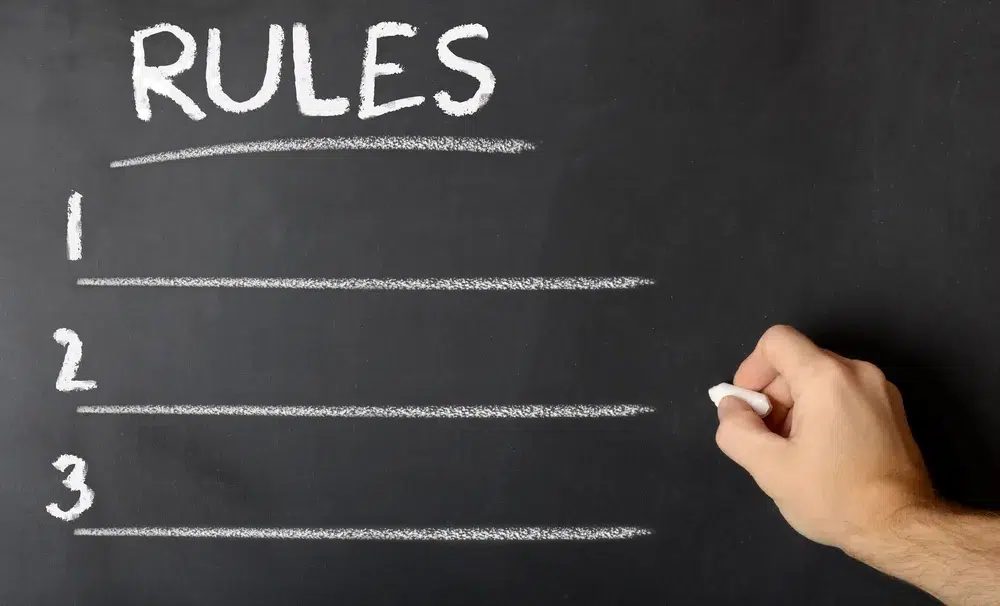
Almost everyone who wonders about this question has written a rulebook. It is usually never on paper, but it exists:
- Only once a week.
- Only softcore, nothing explicit.
- Never on the work laptop.
- Only when my partner is away.
- Delete the apps, and this time they stay deleted.
Each rule was a sincere attempt to keep something under control. That is worth saying plainly: the fact that you wrote rules means part of you already knew this needed managing. People do not make rules for things they can take or leave.
Now look at the rulebook as evidence. Every rule you wrote and then broke is a data point. One broken rule is a bad week. A rulebook full of amendments, exceptions, and fresh starts is a record of loss of control, written in your own handwriting. When a client lays those rules out in front of me and we walk through them together, the pattern usually speaks for itself. By the time most people are sitting in my office and paying for help, they have already seen it. The rulebook just makes it undeniable.
The rules you never break
There is a second page in most rulebooks, and it deserves just as much attention. These are the rules that have held: I never look at anything involving minors. I never look at anything violent. I have never paid for anything.
Those lines matter. In my clinical work, the fact that nearly every client has some moral limit on what they will watch is evidence that their values are intact, and intact values are the raw material recovery gets built from.
But the unbroken rules also get used in a way that is less helpful. I hear them used as proof that things are fine: “I’m not like those people. I have standards.” The line you have never crossed says something good about your values. It does not say anything about whether you are in control of everything on the near side of that line. Holding one firm boundary while the rest of the rulebook keeps getting rewritten is still a picture of compulsion.
The Signs of Porn Addiction You Can Only See From the Inside
Some signs are visible to other people. These four are not. You are the only one who can check them.
Time disappears
You sit down intending ten minutes and look up an hour later. For many people this is the first sign that something has shifted, and it has a clinical explanation. Patrick Carnes, whose work shaped how my field understands sexual compulsion, described an addiction cycle that runs from a trigger, to preoccupation, to ritual, to acting out, and then to despair. The ritual stage is the scrolling, searching, clicking, and hunting for the right thing. Carnes observed that the ritual often matters more than the act itself, because the ritual is where the fantasy state lives and where ordinary reality falls away. Lost time is usually time spent in the ritual.
You use it when you are not even aroused
This is one of the most revealing questions I ask: were you actually aroused when you started, or were you bored, stressed, lonely, restless, or avoiding something?
If porn is showing up when there is no sexual desire behind it, it is doing a different job. It is regulating something. I often ask clients, “What might this be pacifying?” Think of a baby’s pacifier. It does not feed the baby. It soothes the baby, and when you take it away, the baby protests loudly for a while because it was a source of comfort. When porn has become a way to manage boredom, stress, or loneliness, that is a coping mechanism, and often it is covering an attachment need: a longing to feel connected, wanted, or settled that is not being met another way. That longing is valid. The method is the problem.
This is also exactly what the 2024 study found at scale: emotional avoidance and stress reduction were among the strongest predictors of problematic use.
You need more to feel the same
Tolerance is what happens when the same content produces less effect over time. The brain’s reward system adjusts to what it gets used to, so the old material stops working and something newer, longer, or more intense is needed to get the same response.
The Coolidge effect is part of how this works. It is the name researchers gave to the observation that sexual arousal which has dulled with familiarity comes back when something novel appears. In a relationship with a real person, that pull toward novelty is meant to be balanced by attachment and history. Online, novelty is unlimited and one click away, so the reward system is fed a steady supply of “new,” and yesterday’s material becomes today’s baseline.
A 2024 study in Addictive Behaviors by Campbell Ince and colleagues, drawing on two samples of more than 2,000 users, found that this kind of tolerance, needing more to get the same effect, sat at the center of problematic use. It connected binge sessions, tab-jumping between videos, and prolonged sessions to every measured facet of lost control.
Many people notice the rulebook and tolerance working against each other. You tighten the rules, hold them for a while, and then land right back at your old baseline, or past it. That snap-back is one of the clearest signs I know that you are not dealing with a simple habit.
What happens when you try to stop
Irritability, restlessness, intrusive thoughts, and trouble sleeping when you go without are real and well documented. If this is the part you are living, our guide to symptoms of porn withdrawal covers what to expect and why it happens.
What Your Partner May Be Seeing
If you are in a relationship, there is a second lens you can check yourself against. Partners often notice changes long before they find anything concrete, and these are the patterns that tend to register first. Read them honestly and ask whether any of them are true of you.
Device guarding. The phone goes face down, stays on Do Not Disturb, or never leaves your hand. Tabs get closed quickly when someone walks in. Passcodes change.
The long routine. A bathroom trip, a shower, or a morning routine that keeps stretching longer. Staying up after your partner goes to bed. Arriving home later than the drive explains.
Criticism of their appearance. Porn trains the eye toward a curated, filtered, endlessly novel kind of body. Over time, some people become more critical of how their partner looks, or of what their partner wears, without connecting that shift to what they have been watching.
Sex that feels disconnected. Many online checklists say porn addiction makes you lose interest in sex. Some people do. Many others keep having sex with their partner, sometimes often, and it becomes mechanical. The body is there. The person is somewhere else.
I see two things driving this. First, porn trains arousal around watching, not around being present with someone, so many people simply do not know how to be whole-person intimate. Second, the secret life comes into the bedroom with them. When there is something you are hiding, shame is lurking during sex, and you cannot let yourself be fully seen by the person you are with. So the one act designed to bond two people together becomes a place where the attachment gets disrupted instead. Your partner may not be able to name it, but they can usually feel it.
What the Online Checklists Get Wrong
Most “signs of porn addiction” lists were written for a version of the problem that is about fifteen years out of date. Three gaps stand out.
They only look for obvious porn sites
As of 2026, a lot of compulsive use never touches a traditional porn site. It lives in the thirst trap on social media, suggestive but not fully explicit. It lives in short-form video feeds that learn exactly what keeps you scrolling. It lives in written erotica, erotic music videos, and even shopping and product feeds.
The addicted brain is very good at this. It says, “This isn’t porn,” and keeps stimulating the same dopamine circuits. If you have moved from explicit sites to feeds and stories and told yourself that counts as progress, ask whether the function has changed. If it is still how you soothe, escape, or chase a hit, it has not.
Al Cooper, one of the early researchers in this field, explained why internet sexual content hooks people so effectively with three words: Access, Affordability, and Anonymity. It is always available, usually free, and private. Every one of those features applies to a feed on your phone as much as to any website.
They assume you stop wanting sex
As I described above, many people with a real compulsion stay sexually active with their partner. The sex is just not connected. A checklist that asks “have you lost interest in real sex?” lets those people off the hook.
They frame it as an impulse problem
Listicles tend to describe porn addiction as a string of bad decisions. What I see is something more structural: a secret second life, maintained alongside the shared one, with its own routines, rules, and cover stories. Keeping that second world running takes real effort, and the secrecy itself does damage. I have written more about how that split works in how porn addicts compartmentalize.

Can You Cut Back Instead of Quitting?
This is the fork most people are standing at when they read an article like this. One viewer asked it directly in the comments: can you moderate instead of quit?
Here is how one person in an online recovery community put it: “Addiction is a loss of control, and therefore moderation is borderline impossible.”
That sentence captures the clinical distinction well. Moderation is a plan that depends on control. If you had reliable control, you would not have a rulebook full of broken rules. The very thing moderation requires is the thing a compulsion has already taken. That is why, for most people who meet the signs in this article, cutting back tends to turn into a new rulebook with a new set of amendments.
The research has not settled this question. A randomized trial now underway in Germany, the PornLoS program, whose study protocol was published in the Journal of Behavioral Addictions in 2024, is directly comparing an abstinence goal against a reduced-use goal for people with pornography use disorder. Some clinicians favor reduction goals. I respect that, and not everyone will agree with where I land.
My own position is this. I believe porn is harmful to the people who use it, to their relationships, and to the people in the industry who make it, and I can make that case from secular grounds or from my faith. I stay client-centered, and I honor the goals my clients bring. But I believe health comes through quitting. In my experience with clients, porn consistently hits the same dopamine circuits, and I have not seen a version of it that stays in a small, safe box for someone who has already lost control of it.
What I want for my clients is intimacy over intensity: a real partner instead of a virtual fantasy. Recovery is an exchange. You trade a high with no real satisfaction for a deep, abiding satisfaction that won’t replicate the same spike, and nearly everyone I offer that trade to wants it once they see it clearly.
What if you watch rarely and still feel addicted?
Some readers watch once a month and feel like addicts, often because the behavior conflicts with their faith or values. Joshua Grubbs and colleagues call this moral incongruence, and their research shows it contributes to feeling addicted alongside the behavior itself.
Some people take that research to mean the distress is the problem and the porn is fine. I see it differently. If watching once a month is causing you real distress, and you have tried to stop and can’t, that is still worth treating. It is still a maladaptive way of coping, and you deserve better ways to cope. The number being low does not make it healthy.
If You Recognize Yourself, Start Here
If some of these signs fit, here is what I would suggest before anything else.
Write the rulebook down. Every rule you have made about porn, and roughly when each one broke. Put the never-crossed lines on a separate page. Seeing it on paper does what memory never quite does, because memory keeps editing out the evidence.
Ask what it is pacifying. For the next few times you feel the pull, notice what you were feeling right before it. Bored? Stressed? Lonely? Rejected? The pattern you find is the real work.
Stop negotiating with the new formats. If you have moved from explicit sites to feeds, stories, or erotica, count them. The function is what matters, not the file type.
Tell one safe person. A friend, a group, a pastor, a therapist. Secrecy is what keeps the second life running. If you are in a relationship and wondering whether and how to tell your partner, a therapist can help you plan that conversation so it is honest and does not make things worse.
Get a structured plan. Recovery does not run on willpower. Tools like the Three Circle Plan, which defines your bottom lines, your guardrails, and the healthy things you build in, give you a map instead of a rulebook. For what recovery actually looks like over time, see how long it takes to recover from porn addiction.
Work with someone who treats this. Specialized porn addiction counseling focuses on exactly these patterns: the broken rules, the using to cope, the loss of control, and the relationship with your partner that you want to protect.
So, Are You Addicted?
The question is not how much you watch. It comes down to three things.
First, control. Have you tried to stop or cut back and not been able to? Your rulebook will tell you, if you let it.
Second, function. Are you using porn when you are not aroused, to manage boredom, stress, loneliness, or some other feeling? If so, it is doing a job, and that job is usually an attachment need or an emotion looking for a better home.
Third, escalation. Do you need more time, more novelty, or more intensity than you used to, and do your cutbacks keep snapping back to baseline?
If the first one is a yes, or the other two keep showing up, take it seriously. Not because you are beyond help, but because this is very treatable, and the sooner you stop negotiating with it, the sooner you get to the kind of intimacy porn was only ever imitating.
You may still be sitting with a few specific questions. Here are the ones I hear most.
Frequently Asked Questions
Can you be addicted to porn if you only watch once a month?
Yes, if you have tried to stop and can’t, it is compulsive regardless of frequency. Clinically, loss of control and continuing despite consequences matter far more than how often someone watches. In a 2020 network study by Beáta Bőthe and colleagues, viewing frequency was the least central symptom of problematic pornography use, while preoccupation, tolerance, withdrawal, and conflict sat at the center.
I’ve never watched anything extreme. Doesn’t that mean I’m okay?
No, a line you have never crossed shows your values are intact, but it does not show you are in control. Many people hold one firm boundary, such as nothing violent or illegal, while every other rule keeps getting rewritten. The question is whether the rest of your rulebook has held, not whether one page of it has.
Is porn addiction a real diagnosis?
Compulsive porn use can be diagnosed as Compulsive Sexual Behavior Disorder in the World Health Organization’s ICD-11, though “porn addiction” is not a separate diagnosis in the DSM-5. Clinicians still debate whether “addiction” or “compulsion” is the better word. For the person struggling, the label matters less than the pattern: loss of control, escalation, and continued use despite real costs.
Does using porn for stress relief mean I’m addicted?
Using porn to manage stress, boredom, or loneliness is one of the strongest warning signs, even if you are not sure it is an addiction yet. A 2024 study of 112,397 people across 16 countries found that emotional avoidance and stress reduction were among the top predictors of problematic use. When porn becomes your go-to way to regulate feelings, it is functioning as a coping mechanism.
Can I just cut back instead of quitting?
In my clinical experience, lasting health comes through quitting rather than moderating, because moderation depends on the very control that compulsion removes. Some clinicians do support reduction goals, and a randomized trial is currently comparing both approaches. If your past attempts to cut back have kept sliding back to baseline, that history is strong evidence about which path will work for you.
If you are reading this and recognizing yourself, you do not have to sort it out alone. Our team works with compulsive porn use all the time, and a free consultation gives you room to bring your own rulebook and ask the question out loud with someone who has heard it many times before.
Podcast: Play in new window | Download
 October 12, 2026
Recovery from pornography addiction is possible.
Our CSAT-led therapists work with people in exactly your situation. You do not have to figure this out alone.
Take the first step toward recovery